
Glass Chemistry at SUNY Cortland
Glasses, formed when a liquid becomes kinetically trapped in an amorphous, solid-like state upon sufficiently rapid cooling, are of significant importance in fields ranging from organic electronics to coatings to pharmaceuticals. This is generally a consequence of their amorphous structure which allow glasses to, for example, be easily dissolved for pharmaceutical applications. However, the out-of-equilibrium nature of glasses does pose challenges, in particular that a glass may change over time in seeking a state closer to equilibrium. The Wolf lab works to develop strategies to improve crystallization resistance and other origins of instability under consideration in pharmaceutical glass storage. We use methods including spin-coating, and melt-quenching to prepare glasses and compare their properties using microscopy, differential scanning calorimetry, powder X-ray diffraction, and other tools.

Current Projects
Behavior of Amorphous Pharmaceuticals in the Presence of Polymer
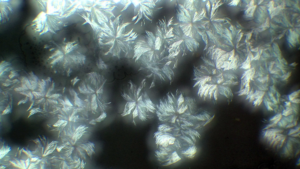
We are preparing amorphous pharmaceuticals in the presences of very small amounts of polymer to study properties including crystallization, liquid fragility, glass transition, physical ageing and others.
Confinement of Amorphous Pharmaceuticals in Thin Films and Nanoparticle Packings
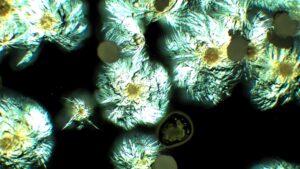 We are spin-coating thin films and of molecular glassformers and infiltrating molecular glassformers into nanoparticle layers to investigate the effect on confinement on crystallization.
Effects of Processing on Crystallization Behavior
We are exploring the effect of processing conditions (including melting temperatures and cooling rates, as well as storage conditions and heat/cool cycles) on crystallization of amorphous drugs.
The views and opinions expressed in this
page are strictly those of the page author. The contents of this linked page have
not been reviewed or approved by SUNY Cortland.